


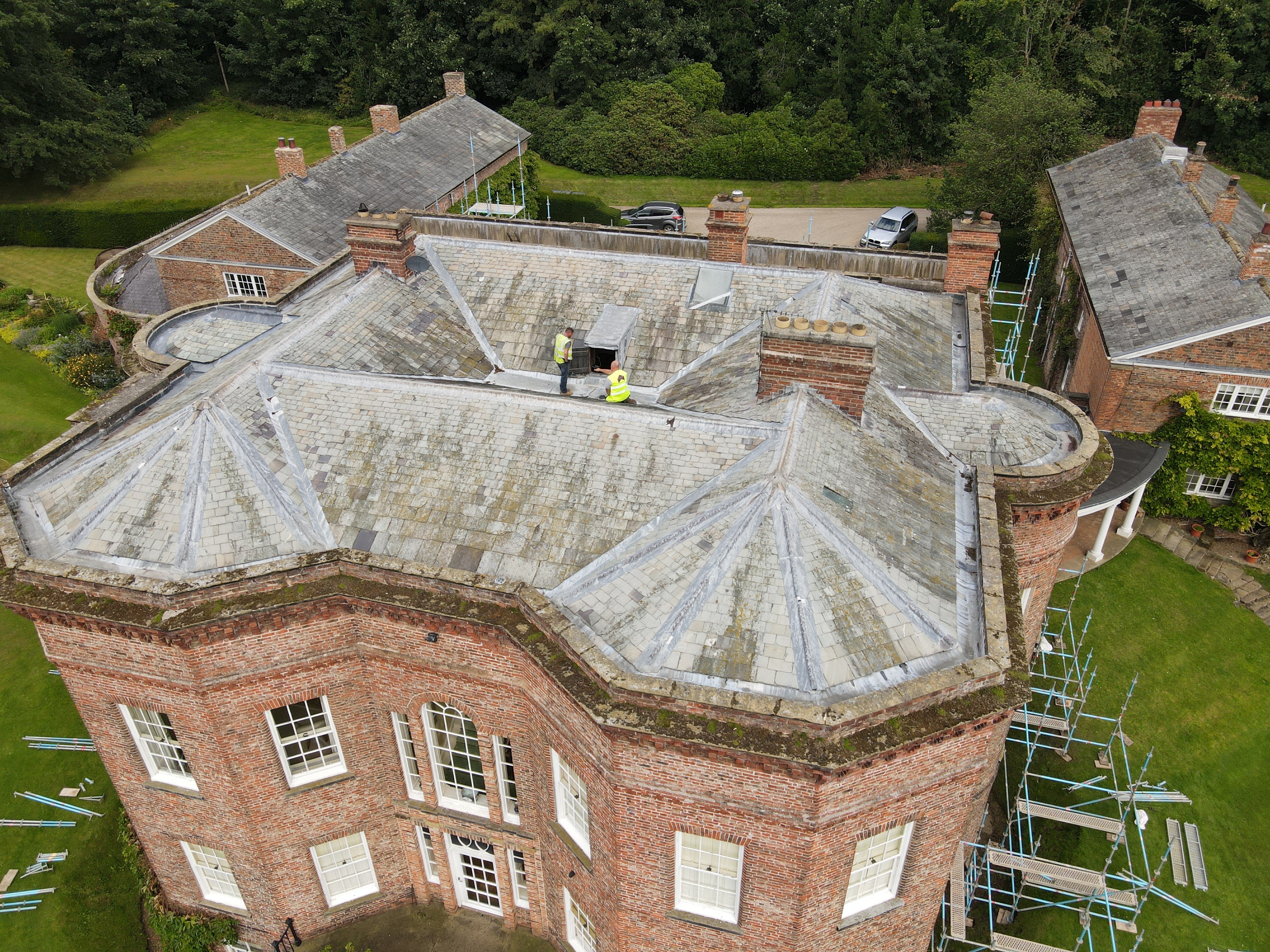
Re-Roofing a Grade II* Listed Building
A major heritage-roofing project involving Westmorland slate, Code 5 lead gutters, concealed drainage, insulation improvements, bat mitigation and traditional detailing.
Specialist Re-Roofing for a Historic Property
Re-roofing a Grade II* listed building requires conservation-led planning, specialist workmanship and close coordination between roofing, leadwork, drainage, insulation and ecology requirements.
This project combined traditional Westmorland slate and rolled lead sheet with modern insulation, concealed drainage improvements and carefully planned bat mitigation.
A detailed specification and method statement were central to defining materials, responsibilities, sequencing, retained fabric and hidden-defect procedures.
Existing materials were retained and reused wherever they remained serviceable, with reclaimed matching material introduced only where shortages occurred.
Watch the Project Before, During and After
The original project video is retained below and provides a visual overview of the listed-building roofing work.
History of the Property
Built around 1770 by Leonard Smelt, the property occupies a prominent position above the River Swale in North Yorkshire.
The building is surrounded by parkland, agricultural land and floodplain, with long-distance views toward the Cleveland Hills, Nidderdale, the North Pennines and the Lake District.
The property was remodelled extensively during the mid-nineteenth century and reduced in size during the 1960s.
Westmorland Slate
The roof was covered in diminishing courses of traditional Westmorland slate.
Concealed Lead Gutters
Perimeter gutters sat behind a brick parapet with stone copings.
Internal Drainage
The roof discharged inward to concealed tanks rather than external downpipes.
Historic Alterations
The roof and drainage arrangement reflected nineteenth- and twentieth-century changes.
Prominent Setting
The building’s elevated setting increased the importance of material and visual compatibility.
Conservation Significance
Every intervention had to respect the building’s architectural and historic value.
The Agreed Scope of Work
Slate Removal and Reuse
Carefully remove and reinstate existing Westmorland slate, supplementing shortages with reclaimed matching material.
Lead Gutter Renewal
Replace timber substrates and install new Code 5 lead linings to concealed perimeter gutters.
Insulation Upgrade
Improve thermal performance while respecting the existing roof form and applicable requirements.
Chimney Flashings
Renew lead flashings to chimney stacks and associated roof interfaces.
Glazed Roof Panels
Install new glazed panels with lead perimeter details in selected locations.
Bat Mitigation
Include measures to protect bats and maintain suitable access points.
Concealed Drainage and Traditional Lead Details
Purpose-Made Holding Tanks
Modern underground drainage components were incorporated into new internal holding tanks.
Concealed Downpipes
Water was redirected through two concealed fall pipes behind the later façade.
Lead Overflow Details
Code 5 lead overflows were included as an early-warning measure for future blockages.
Lead Hips and Ridges
Timber king rolls and stainless-steel clips secured renewed hip and ridge details.
Stepped Lead Gutters
The parapet arrangement was used to create suitable falls and steps within the lead-lined gutters.
Managed Tank Removal
Five large galvanised tanks were removed from the loft using a fully managed crane lift.
Because concealed systems can hide developing defects, reliable falls, overflow routes, accessible maintenance points and inspection procedures are especially important.
What Must Be Resolved Before Work Begins?
- Confirm whether listed-building consent is required for the proposed changes.
- Agree which original slate, lead, timber and masonry elements will be retained.
- Define acceptable reclaimed replacement materials.
- Coordinate Building Regulations requirements with conservation objectives.
- Identify ecological constraints, including bat surveys and mitigation.
- Prepare scaffold, access and public-protection proposals.
- Document hidden-defect and variation procedures.
- Agree photography, records and completion documentation.
Listed-building roofing commonly involves the owner, contractor, conservation officer, surveyor or architect, building-control body and ecological adviser.
Work Completed at the Time of the Original Update
Lead-Lined Gutters
The new gutters and associated joinery had been installed.
Roofing Membrane
The roof had been covered and bat-mitigation measures incorporated.
Loft Insulation
The loft had been cleaned and fully insulated.
Internal Drainage
The concealed drainage system had been installed and tested.
Structural Coordination
Joinery, leadwork and drainage details were coordinated before slate reinstatement.
Conservation Records
Progress was documented to support project control and heritage decision-making.

Listed-Building Roofing FAQs
Can a Grade II* listed building be re-roofed?
Yes, but the proposed changes, materials and methods should be agreed through the appropriate conservation and consent process.
What is the difference between Grade II and Grade II*?
Grade II* buildings are particularly important and of more than special interest, so proposed roofing changes may require especially careful justification and documentation.
Can original Westmorland slate be reused?
Sound slate can often be retained and reused after careful stripping, sorting and assessment, with compatible reclaimed slate used for shortages.
Why use Code 5 lead on heritage roofs?
Code 5 rolled lead sheet can suit gutters, valleys and other details where the design, sheet sizes, substrate and movement allowance are appropriate.
Do listed-building roof repairs need consent?
Work affecting the building’s special architectural or historic interest may require listed-building consent. The position should be confirmed before work begins.
Can insulation be added to a historic roof?
Often, yes, but the thermal and moisture design must respect the existing building fabric and avoid creating condensation or trapping moisture.
What happens if bats are found?
Work may need to pause while ecological advice, licensing and mitigation requirements are confirmed.
Why are concealed gutters higher risk?
They can hide blockages and leaks, making reliable falls, overflows, inspection access and maintenance especially important.
How long does a heritage reroof take?
Duration depends on roof size, access, weather, consent conditions, material salvage, ecology, leadwork and hidden defects.
What should I look for in a heritage roofing contractor?
Look for comparable project evidence, specialist slate and leadwork skills, clear documentation, suitable insurance and understanding of conservation-led repair.
Discuss a Listed-Building Roofing Project
Neal Roofing can support surveys, Westmorland slate, rolled lead sheet, concealed drainage, chimneys, insulation and coordinated conservation roofing projects.