Zinc Roofing Standards and FTMRC Guidance
A contractor-led guide to architectural zinc, standing seams, roof build-ups, thermal movement, ventilation, maintenance and the role of the FTMRC.
What is architectural zinc roofing?
Architectural zinc is a lightweight, formable metal used for fully supported roofs, façades, dormers, canopies, gutters and complex weathering details.
Zinc develops a protective surface patina as it weathers. This gives the material its recognisable appearance and helps protect the underlying metal.
Durable performance depends on much more than the sheet itself. Roof pitch, substrate, ventilation, moisture control, thermal movement, clip design, seam geometry, compatible materials and skilled installation must all be coordinated.
A zinc roof is a complete build-up—not just a metal finish
Problems often begin below the visible sheet through unsuitable decks, trapped moisture, insufficient ventilation or poor movement detailing.
Why choose zinc roofing?
Long service potential
Correctly designed and installed zinc can provide a long-lasting roofing and cladding finish.
Protective patina
The natural weathered surface helps protect the metal and develops visual character over time.
Lightweight material
Zinc can offer a lower covering weight than many traditional roof materials.
Complex geometry
The material can be formed around curved roofs, dormers, turrets and architectural details.
Modern appearance
Standing seams and clean lines suit contemporary extensions and commercial architecture.
Low routine maintenance
Once established, zinc normally needs inspection and drainage maintenance rather than regular painting.
Recyclability
Zinc can be recovered and recycled at the end of its service life.
Architectural flexibility
Available finishes and detailing methods allow zinc to suit both traditional and modern buildings.
Types of zinc roofing
Standing seam
Long trays are joined with raised seams and fixed using concealed clips that allow controlled movement.
Flat lock
Smaller panels interlock on all sides and are commonly used for façades, dormers and detailed areas.
Batten roll
Traditional raised rolls create a stronger visual rhythm and can suit heritage or feature roofs.
Reveal panels
Flat panels with expressed joints create a clean architectural façade treatment.
Zinc shingles
Smaller overlapping units can suit complex geometry, curved surfaces and decorative work.
Curved zinc roofs
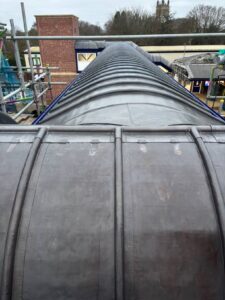
Formability allows zinc to follow barrel roofs, domes and other complex profiles.
The visual system must also suit pitch, exposure and geometry
Standing seam, flat lock and batten roll details have different drainage, fixing and pitch requirements.
Typical zinc roof build-up
Supporting structure
Rafters, joists or engineered structure sized for the roof and imposed loads.
Air and vapour control
Controls internal moisture movement where required by the build-up.
Insulation
Positioned to suit warm-roof or ventilated-roof design and continuity requirements.
Structural deck
Provides smooth, stable and continuous support for the zinc system.
Ventilation cavity
Used where the design requires airflow below the metal covering.
Separating layer
Protects the underside of zinc and supports drainage or ventilation where specified.
Clips and fixings
Secure trays while allowing designed thermal movement.
Zinc covering
Formed trays, panels, seams, flashings and perimeter details complete the weathering layer.
Warm and ventilated zinc roofs are not interchangeable details.
The complete moisture and ventilation strategy should be established before the deck and metal are installed.
Why zinc must be allowed to expand and contract
Zinc changes dimension as temperature changes. Trays, seams, clips and junctions must accommodate this movement without tearing, buckling or opening.
Fixed clips
- Establish the designed fixed point.
- Control the direction of tray movement.
- Must be positioned according to tray length and roof geometry.
- Should not over-restrain the complete sheet.
Sliding clips
- Allow longitudinal movement as temperatures change.
- Require correct spacing and compatible fixings.
- Must remain free to move after seaming.
- Help prevent fatigue and distortion.
Tray length
Longer sheets experience greater total movement and may need special design measures.
Fixed-point position
The location determines the direction in which expansion and contraction occur.
Perimeter details
Eaves, ridges, abutments and penetrations must allow movement without opening.
Seam geometry
Poorly formed seams can restrict movement or create water-entry points.
Expansion joints
Very long runs or complex layouts may require deliberate movement breaks.
Temperature during installation
Ambient conditions affect the movement allowance available after completion.
Ventilation, vapour control and underside corrosion
Ventilated roof considerations
- Continuous airflow path.
- Openings sized for the roof design.
- Insect protection without blocking ventilation.
- Unobstructed cavity at eaves and ridge.
- Coordination around rooflights and penetrations.
Warm roof considerations
- Continuous insulation.
- Effective air and vapour control layer.
- Sealed laps and penetrations.
- Compatible separating membrane.
- Manufacturer-approved system design.
Persistent underside moisture can damage zinc
Condensation, wet decks, trapped construction moisture or blocked ventilation can cause underside corrosion even when the external zinc looks intact.
Suitable substrates, fixings and adjacent metals
Timber boarding
Traditional boards can provide a suitable ventilated support where dry, smooth and correctly detailed.
Plywood
May be used within approved build-ups when grade, thickness, fixing and moisture condition are correct.
OSB
Suitability depends on system approval, exposure class, surface condition and moisture control.
Separating layers
Structured or compatible membranes may support drainage, ventilation and underside protection.
Stainless-steel fixings
Often used for clips and system components because of corrosion resistance and compatibility.
Adjacent metals
Runoff and direct contact from copper or other materials can create compatibility risks.
Treated timber
Some preservatives and wet timber conditions may be unsuitable in contact with zinc systems.
Sealants and coatings
Only compatible products should be used where the system manufacturer permits them.
What is the FTMRC?
The Federation of Traditional Metal Roofing Contractors is a specialist trade association focused on fully supported metal roofing and cladding.
Good-practice information
Supports contractors and specifiers with specialist fully supported metal roofing knowledge.
Membership criteria
Membership provides an industry-level quality signal subject to the federation’s current requirements.
Skills development
Promotes education, seminars and specialist craft development across the sector.
Representation and advice
Supports discussion of materials, workmanship, standards and sector development.
Potential membership benefits
- Specialist technical guidance.
- Industry recognition.
- Training and continuing development.
- Networking with manufacturers and contractors.
- Access to current member support arrangements.
- Potential guarantee routes where current scheme rules allow.
What membership does not replace
- Project-specific design.
- Manufacturer requirements.
- Competent individual craftspeople.
- Correct moisture and movement strategy.
- Inspection and quality control.
- Clear contractual responsibility.
Neal Roofing is not currently an FTMRC member
The company does not claim current FTMRC membership or member-only benefits. Zinc projects are delivered through experienced teams, recognised installation principles, manufacturer guidance, internal quality controls and project-specific warranties.
Common zinc roofing installation mistakes
Insufficient movement allowance
Over-restrained trays can buckle, split or distort as temperatures change.
Incorrect clip layout
Poor fixed and sliding clip design can prevent controlled thermal movement.
Unsuitable substrate
Rough, wet or unstable decks can damage the zinc or create uneven finished work.
Blocked ventilation
Interrupted airflow can increase condensation and underside corrosion risk.
Poor seam formation
Loose, damaged or uneven seams can compromise weathering and movement.
Incompatible metals
Direct contact or runoff from certain metals can accelerate corrosion.
Construction moisture
Covering wet decks or trapping moisture can damage the underside of zinc.
Scratched finishes
Poor handling and storage can mark pre-weathered surfaces and visible panels.
Weak interface details
Eaves, ridges, rooflights, abutments and penetrations often fail before the main field area.
How should zinc roofing be maintained?
Inspect visually
Review seams, edges, flashings, penetrations and visible distortion.
Clear drainage
Remove leaves and debris from gutters, outlets and water paths.
Check adjacent materials
Identify runoff, staining, sealant failure or incompatible repairs.
Review ventilation
Keep ventilation openings clear and investigate condensation signs.
Inspect after works
Check for punctures or scratches after scaffold, solar or service access.
Repair early
Address local defects before water reaches the deck or insulation.
Avoid rigid patching
Repairs must continue to accommodate movement rather than locking the sheet.
Maintain records
Keep photographs, reports, warranties and previous repair details.
Neal Roofing zinc projects
Neal Roofing delivers architectural zinc roofing for residential, commercial, heritage and contemporary projects across Yorkshire and the North of England.
Survey-led specification
Roof geometry, build-up, pitch, movement, ventilation and interfaces are reviewed before installation.
Skilled craftsmanship
Experienced teams form trays, seams, flashings and complex architectural details.
Premium zinc systems
Established architectural-zinc products and finishes are selected to suit the project.
Building-envelope coordination
Zinc is integrated with insulation, underlays, cladding, leadwork and adjacent roof systems.
Zinc roofing and FTMRC FAQs
How long does zinc roofing last?
There is no universal guaranteed lifespan. Correctly specified and installed architectural zinc can provide long service, but performance depends on build-up, exposure, detailing, moisture control and maintenance.
Does zinc rust?
Zinc forms a protective patina rather than rusting in the same way as untreated steel. Poor moisture conditions or incompatible materials can still cause corrosion.
Does zinc change colour?
Natural zinc changes as the patina develops. Pre-weathered products provide a more established appearance from installation.
What is zinc patination?
Patination is the natural development of a protective surface layer as zinc reacts with the atmosphere.
Does zinc roofing need painting?
Normally no. Architectural zinc is selected for its own weathering surface rather than a painted finish.
Is zinc roofing noisy?
Noise depends on roof build-up, insulation, deck and internal finishes. A correctly designed supported system should not be judged from the metal sheet alone.
Can zinc be used on low-pitch roofs?
Some standing-seam systems can suit relatively low pitches, but manufacturer limits, seam type, tray length and exposure must be checked.
What thickness of zinc is used for roofing?
Thickness depends on the system, panel dimensions, exposure and manufacturer guidance. The project specification should state the actual product and thickness.
Why does zinc expand and contract?
Like other metals, zinc changes dimension with temperature. Clips and details must allow that movement safely.
What are fixed and sliding clips?
Fixed clips establish a controlled point, while sliding clips secure the tray but allow longitudinal movement.
What roof deck is required beneath zinc?
The deck must be smooth, stable, dry and approved for the selected system. Timber boards, plywood or other products may be suitable depending on the design.
Can zinc be installed over old felt?
Not without proper assessment. Existing felt, moisture, deck condition and compatibility must be reviewed before any overlay approach is considered.
Does zinc roofing need ventilation?
Some zinc roofs use a ventilated cavity; others use an approved warm-roof build-up. The correct strategy depends on the whole design.
What causes underside corrosion in zinc?
Persistent condensation, trapped moisture, wet decks, blocked ventilation and incompatible contact materials are common causes.
Can zinc roofing be repaired?
Yes. Local defects can often be repaired, but the method must preserve thermal movement and material compatibility.
Is zinc suitable for coastal environments?
Suitability depends on exact exposure, product finish, runoff, maintenance and manufacturer advice. Coastal projects require project-specific assessment.
Can zinc be used on heritage buildings?
Yes, where historically or architecturally appropriate and where consent requirements are satisfied.
Is zinc environmentally friendly?
Zinc is recyclable and can provide long service. Environmental assessment should still consider extraction, manufacturing, transport, installation and lifecycle.
Why is zinc roofing expensive?
Cost reflects specialist materials, skilled labour, detailed setting out, complex interfaces and the need for a complete technically coordinated build-up.
What maintenance does zinc roofing require?
Routine work generally includes inspection, clearing drainage, checking interfaces, keeping ventilation paths open and repairing accidental damage.
Does zinc scratch?
Yes. Pre-weathered and natural finishes can be marked by poor handling, sharp tools or site traffic.
What is the FTMRC?
It is a specialist trade association focused on traditional and fully supported metal roofing and cladding.
Is FTMRC membership compulsory?
No. It is voluntary trade-association membership rather than a statutory licence.
Is Neal Roofing an FTMRC member?
No. Neal Roofing does not currently claim FTMRC membership or member-only benefits.
What should a zinc roofing quotation include?
It should identify system type, zinc product, thickness, deck, insulation, vapour control, ventilation, separating layer, clips, details, access, warranty and exclusions.
Authoritative supporting information
Membership arrangements, technical guidance and manufacturer requirements can change. Confirm the current project specification before installation.
Discuss your zinc roofing project
Speak to Neal Roofing about standing seam zinc, architectural detailing, roof build-ups, surveys and specialist metal-roofing installation.